The aircraft descends over an endless sea of emerald rainforest, rivers threading through landscapes that stretch beyond the horizon. Visitors arriving in the Democratic Republic of the Congo tend to go quiet the moment they realize the scale of what they’re entering.
This is Africa’s second-largest country — home to the world’s second-largest tropical rainforest, the only place on Earth where both mountain gorillas and bonobos live in the wild, nine national parks, more than 200 waterfalls, active volcanoes, and Atlantic beaches. Most travelers arrive expecting difficulty. What surprises them is the scale of possibility.
Here’s an overview of gorilla trekking in the DRC.
A note before you read: Travel conditions in the DRC change frequently. As of mid-2026, multiple Western governments carry “Do Not Travel” advisories for the country, and eastern regions including North Kivu remain affected by armed conflict and a declared Ebola outbreak in Ituri Province. This article reflects the destination’s genuine wildlife and cultural potential. Anyone planning travel should check current advisories from their government and travel only with operators who maintain direct security coordination with park authorities.
Kinshasa Nature Safari: Congo River, Waterfalls & Wildlife
Most people don’t know that one of Africa’s most biodiverse safari circuits starts less than two hours from a capital city. This six-day expedition explores the wild landscapes surrounding Kinshasa — waterfalls, river islands, savanna reserves, and the Congo River itself — without requiring a flight into the interior.
What the six days cover:
- Vampa Falls and Zongo Falls in Kongo Central — two powerful waterfalls set in tropical forest, with hiking and photography time
- An overnight stay at Zongo Safari Eco-Lodges
- A private boat expedition on the Congo River, passing fishing villages and exploring river islands
- Wildlife viewing at Nsele Valley Park — zebras, antelopes, buffalo, ostriches, and over 200 bird species recorded in the area
- Nature walks and birdwatching in Bombo-Lumene Reserve, a protected savanna ecosystem
- Cultural visits in Kinshasa: the National Museum of the DRC, artisan markets, and the city’s music scene
- All transport by private 4×4 with a professional English/French-speaking guide
- Entrance fees, park guides, airport transfers, and accommodation included
Duration: 6 days | Difficulty: Easy | Departs from: N’djili International Airport, Kinshasa
Before booking, check your government’s current travel advisory for the DRC and ensure your travel insurance covers the region, including emergency evacuation.
What Gorilla Trekking in the DRC Actually Looks Like
The journey begins before sunrise. Cool air, distant birdsong, mist sitting over the mountains. Trackers move quietly ahead, reading signs most visitors would never notice.
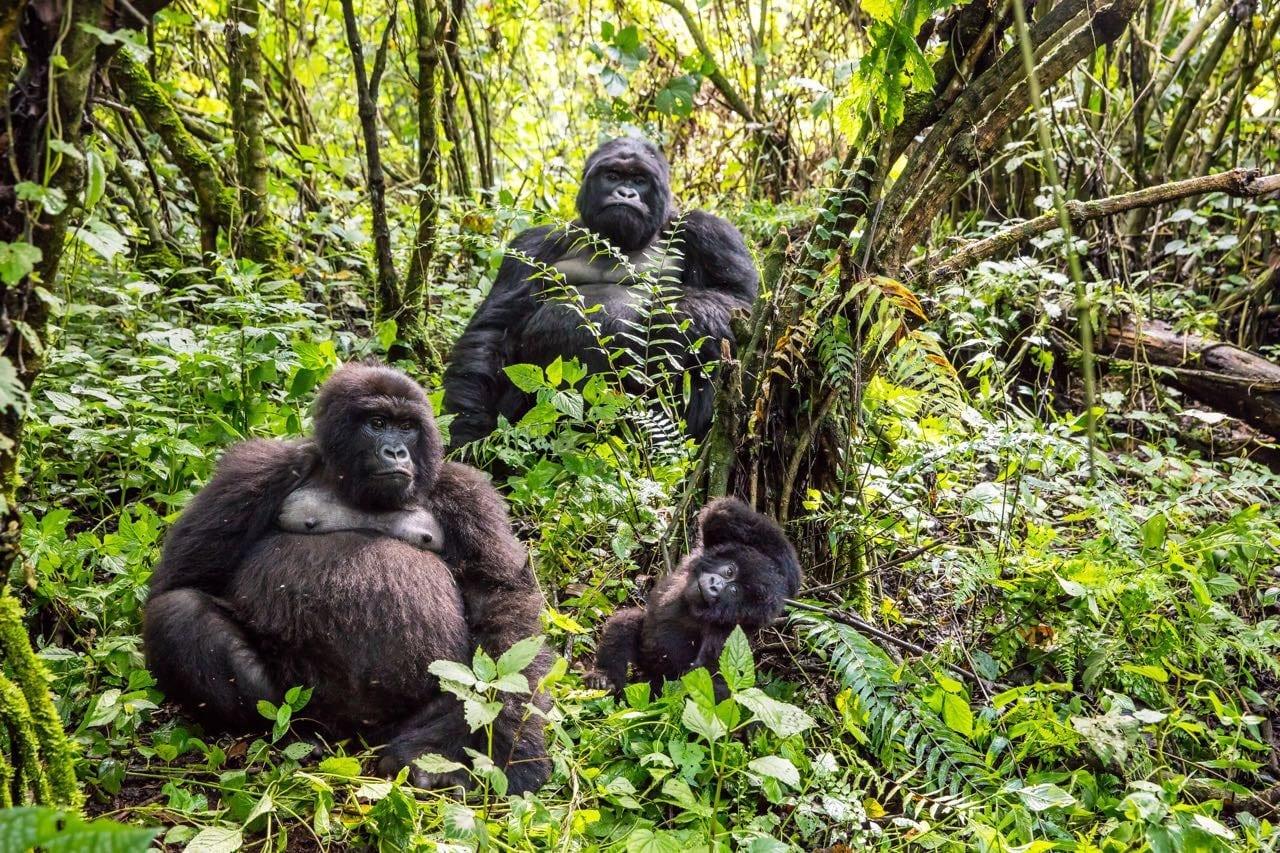
One traveler, who had been across several African countries, described spending several hours moving through mist-covered forest before the group stopped. Just meters away, a large silverback emerged from the vegetation, followed by his family. He stood completely still as the silverback looked toward the group, then continued feeding. He said later that was the moment the trip shifted — from visiting a destination to understanding why people dedicate their lives to protecting these animals.
That quality of encounter, in a landscape with relatively few other visitors present, is what distinguishes gorilla trekking in the DRC from the more heavily trafficked experiences in Rwanda and Uganda.

Beyond Gorillas: The Full Scale of Discovery
Most travelers focus on the gorilla experience and discover the rest by accident. The volcanic landscapes around Mount Nyiragongo produce a terrain unlike anywhere else in Africa. The Lofoï and Zongo waterfalls show what the Congo’s river systems do when they have room. The mangrove forests near Moanda on the Atlantic coast are an entirely different ecosystem within the same country.
Sections of the Congo River — the second-longest in Africa — pass through landscapes few international visitors have seen. Local communities along the way carry histories passed down through generations. The cultural depth tends to catch people off-guard: Congolese rumba and traditional drums, markets with grilled fish, roasted plantains, cassava, palm nuts, and tropical fruits. The smell of a market after tropical rain, mixing with forest soil, is specific to this place.

The Scale of the Ecosystem
Experienced travelers often say the Congo Basin changed their understanding of what wilderness means. It’s not only about seeing rare animals. It’s about being inside an ecosystem that operates on its own schedule — one where a family of gorillas moves through their territory paying little attention to observers, and visitors feel, perhaps for the first time, like guests in someone else’s home.
The physical demands are real but manageable for most fitness levels. Treks through dense vegetation require patience, but guides adjust routes based on each group. The reward is partly the destination and partly the pace — moving slowly enough to hear the forest’s layers of sound, to notice the connections that hold this ecosystem together.

Working With Local Conservation Heroes
The rangers and trackers who make gorilla trekking possible in the DRC work in genuinely difficult conditions. Virunga National Park, managed by the Virunga Foundation, has operated through decades of conflict, and the staff who protect its wildlife do so at considerable personal risk. Tourism revenue directly supports ranger salaries, community development programs, and conservation infrastructure — which means choosing to visit, when conditions allow, has a measurable impact beyond the individual experience.
Local guides bring knowledge of the forest that goes well beyond animal tracking. They understand the social dynamics of specific gorilla families, the seasonal patterns of movement, and the ecological relationships that make this habitat function. That knowledge, shared during a trek, turns an encounter with wildlife into something closer to an education.
The Unexpected Moments That Define the Journey
Travelers who have made the journey describe a particular kind of memory that stays with them: not the headline encounter, but the details around it. The sound of rain approaching through a forest canopy before it arrives. A juvenile gorilla pausing to watch the group with what looks like genuine curiosity. The moment when a tracker communicates something through gesture alone and everyone understands without words.
These details accumulate into something harder to name than a highlight reel. The DRC, for travelers who go in with clear eyes about the challenges and appropriate preparation, tends to deliver experiences that resist easy summary.
Practical Information For Gorilla Trekking in the DRC
Entry requirements: A visa is required for most nationalities. Visas can be obtained through Congolese embassies or, in some cases, on arrival — confirm current requirements with your embassy well in advance.
Health precautions: Yellow fever vaccination is required. Malaria prophylaxis is strongly recommended. Consult a travel health clinic at least six to eight weeks before departure. As of mid-2026, an Ebola outbreak has been declared in Ituri Province — check current health advisories before travel.
Best time to visit: The DRC has two dry seasons — June to August and December to February — when trekking conditions are generally more favorable. Gorilla trekking is possible year-round, but wet season trails are significantly more demanding.
Permits: Gorilla trekking permits in the DRC have historically been priced lower than those in Rwanda (where permits cost $1,500 USD) or Uganda ($700 USD), making the DRC a more cost-effective option for budget-conscious travelers when access is possible. Permit availability and pricing should be confirmed directly with park authorities or a licensed operator, as conditions change.
Operators: Travel with operators who maintain active relationships with park authorities and real-time security monitoring. This is not a destination where independent travel into gorilla trekking areas is advisable.
Insurance: Comprehensive travel insurance that includes emergency medical evacuation is essential. Standard policies frequently exclude conflict-affected regions — read your policy carefully and secure specialist coverage if needed.
Frequently Asked Questions
Is it safe to travel in the Democratic Republic of the Congo right now?
Safety varies significantly by region and changes over time. Western areas including Kinshasa and parts of Kongo Central are generally more stable. Eastern regions, including North Kivu — where Virunga National Park is located — have experienced ongoing armed conflict and carry “Do Not Travel” advisories from multiple Western governments as of mid-2026. Anyone planning travel should check current advisories from their own government, travel with operators who have active security coordination on the ground, and carry appropriate insurance including emergency evacuation cover.
Is Virunga National Park currently open for gorilla trekking?
Virunga National Park has a history of periodic closures due to security conditions and has operated with restricted access in recent years. Current status should be confirmed directly with the Virunga Foundation before making any plans.
What’s the difference between mountain gorillas and bonobos in terms of viewing experiences?
Mountain gorillas live in highland forest and are tracked on foot through mountainous terrain. The DRC’s gorilla trekking, centered on Virunga, follows this model. Bonobos — found only in the DRC — live in lowland rainforest and can be visited through sanctuaries and limited wild-encounter programs in areas closer to Kinshasa, such as Lola ya Bonobo. The behavioral differences between the two species are significant: bonobos are notably more peaceful in their social structure and interact differently with observers.
How physically demanding are the treks compared to gorilla trekking in Rwanda or Uganda?
Trekking difficulty depends heavily on where the gorilla families are on any given day. In Virunga, the volcanic terrain can be steep and the vegetation dense. Conditions are broadly comparable to Uganda’s Bwindi Impenetrable Forest and can exceed Rwanda’s Volcanoes National Park in difficulty on harder days. Most reasonably fit adults complete the treks successfully, though altitude and humidity are factors to account for.
What cultural interactions happen beyond wildlife experiences?
The DRC has a rich cultural life that extends well beyond wildlife. Kinshasa is one of Africa’s major music cities, with Congolese rumba recognized by UNESCO as Intangible Cultural Heritage. Local markets, river communities, traditional craft production, and community visits led by local guides all form part of the broader travel experience. Operators offering itineraries that combine wildlife and cultural components tend to produce more complete journeys.
How does visiting the DRC contribute to conservation and local communities?
Permit fees and operator revenues directly fund ranger salaries, anti-poaching operations, and community development programs. In Virunga, tourism income has historically been one of the primary sustainable funding sources for conservation work. Local employment — guides, trackers, lodge staff, and community liaisons — means that visitor spending circulates in areas where economic alternatives are limited. Conservation organizations operating in the DRC have documented a direct link between visitor numbers and the resources available for wildlife protection.
What makes the Congo Basin different from other African rainforest experiences?
Scale and biodiversity. The Congo Basin is the world’s second-largest tropical rainforest and contains species found nowhere else on Earth. Unlike more accessible rainforest destinations, infrastructure in much of the DRC remains limited, which means encounters feel genuinely remote. The combination of great apes, forest elephants, okapis, hundreds of bird species, and river ecosystems within a single destination has no equivalent elsewhere on the continent. For travelers with the preparation and risk tolerance the destination requires, that combination is the defining factor.
The DRC demands more preparation, more flexibility, and more acceptance of uncertainty than most travel destinations. For those who go in with clear expectations and proper support, it tends to deliver encounters with wilderness — and with themselves — that few other places can match.